If water is appearing near your fireplace after a rainstorm, failed chimney flashing is almost certainly the cause — the thin metal seal where your chimney meets your roof, not a cracked crown or a missing cap. Bellevue's maritime winters deliver 37 to 40 inches of rain annually in prolonged soaking events that give water hours to exploit the smallest gap, and when that flashing seal breaks, water tracks down the interior masonry straight into your framing, attic, and ceilings. A professional re-flash — typically $350 to $900 for most Bellevue single-family homes — stops that damage before it becomes a five-figure structural repair.
What Is Chimney Flashing and Why Does It Fail So Often on Eastside Homes?
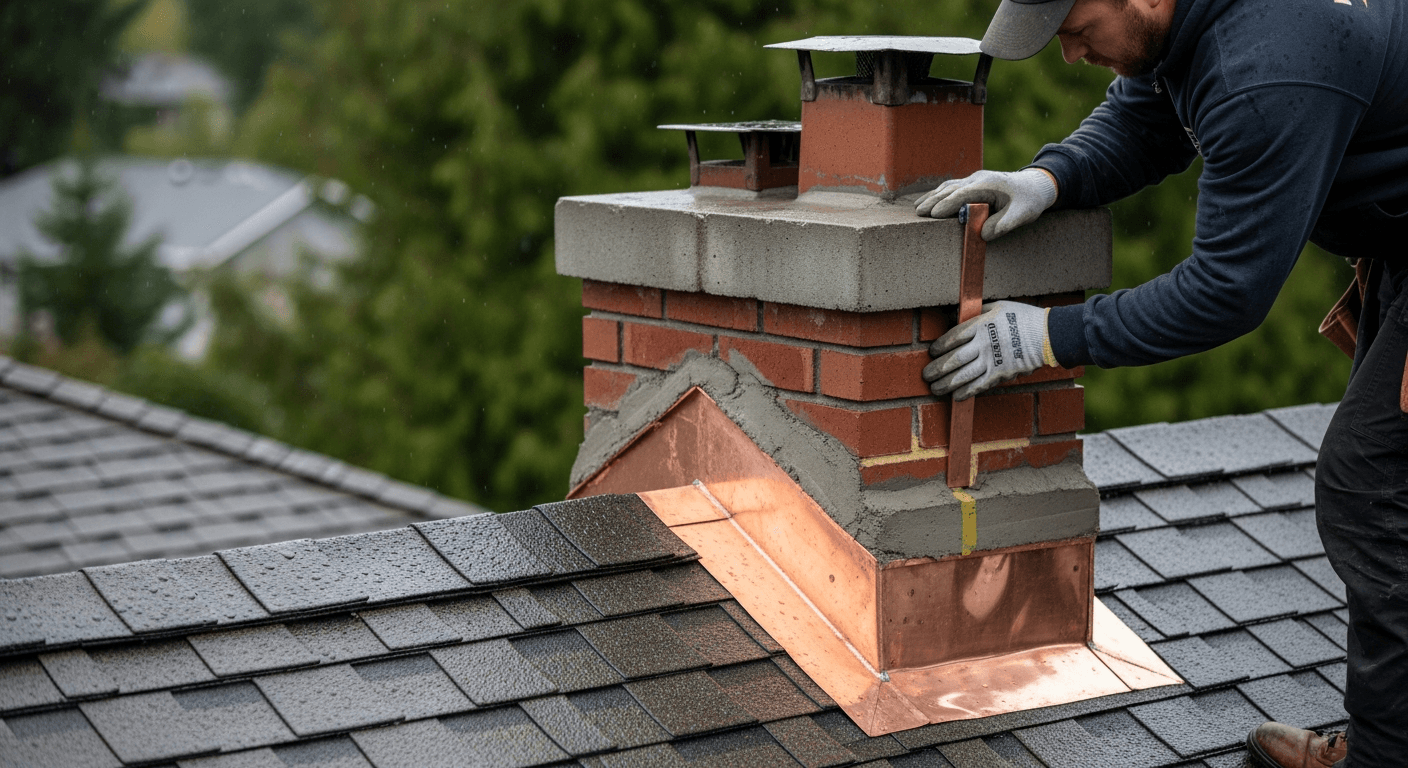
Chimney flashing is a two-part sheet-metal system installed where your chimney penetrates the roofline. Step flashing — individual L-shaped pieces — weaves between shingles along each side of the chimney. Counter flashing (also called cap flashing) folds down from a reglet cut into the mortar joints above, lapping over the step flashing to create a layered, water-shedding barrier. When both layers work together, rain sheds off the roof without ever reaching the wood structure beneath.
Bellevue's climate puts this system under exceptional stress. The Eastside's 37 to 40 inches of annual rainfall arrives mostly as prolonged soaking events — not brief showers — giving water hours to find the smallest gap. Thermal cycling does the rest: nightly lows in the 30s and daytime highs in the 50s through winter cause the metal to expand and contract repeatedly, slowly breaking the bond between the counter flashing edge and the mortar joint. Many of the masonry chimneys we service in Bridle Trails, Somerset, Lakemont, and Phantom Lake are 25 to 45 years old and have already endured tens of thousands of thermal cycles on their original flashing.
The failure modes we encounter most often: mortar joints that have cracked and released the embedded counter flashing edge; roofing cement used as a caulk substitute during a past repair that has since dried, shrunk, and separated; and step flashing installed with insufficient overlaps that allows water to wick upward beneath the shingles. We also regularly find aluminum flashing that has corroded where it contacts treated lumber or the tannins in cedar shakes — both materials prevalent in Eastside construction from the 1980s and 1990s.
How Much Does Chimney Flashing Repair Cost in Bellevue?
Repair cost depends on three variables: how much of the flashing system needs replacement (targeted spot repair versus a full four-side re-flash), the metal specified, and whether surrounding shingles must be lifted to access the step flashing. The table above reflects actual price ranges on Bellevue residential jobs in 2024 and 2025 for standard chimneys on single-story and two-story homes accessible by extension ladder. Steeply pitched roofs — common on the hillside lots in Somerset and Lakemont — or chimneys set high on complex rooflines may carry an additional safety-rigging charge.
Copper flashing carries a higher upfront cost but is the correct long-term specification for higher-value Eastside homes: it outlasts the masonry itself, develops a self-protective patina, and has zero corrosion risk in our environment. Galvanized steel is the practical mid-range option with a 15-to-20-year service life when properly installed. We do not specify aluminum on new installs because of its documented corrosion risk against treated lumber and organic debris in Pacific Northwest conditions. Regardless of material, counter flashing must be mechanically embedded into a cut mortar reglet and sealed with flexible polyurethane — surface-mounting with tar or caulk alone is not an acceptable permanent repair.
| Repair Type | Material | Typical Cost Range (Bellevue, 2024–2025) | Expected Lifespan |
|---|---|---|---|
| Spot re-seal only (repoint and recaulk existing flashing) | Existing flashing retained | $150 – $350 | 3 – 7 years |
| Partial re-flash (one or two sides) | Galvanized steel | $350 – $600 | 15 – 20 years |
| Full re-flash (all four sides) | Galvanized steel | $600 – $900 | 15 – 20 years |
| Full re-flash (all four sides) | Copper | $950 – $1,600 | 50+ years |
| Re-flash plus surrounding shingle repair | Galvanized steel | $800 – $1,400 | 15 – 20 years |
| Re-flash plus surrounding shingle repair | Copper | $1,200 – $2,000 | 50+ years |
How to Tell If Your Chimney Is Leaking Through the Flashing (And Not Somewhere Else)
Chimney leaks have several distinct sources, and misidentifying them leads to expensive repairs that solve the wrong problem. Flashing failure is the most common cause, but a cracked chimney crown, spalling brick faces, or a missing chimney cap each produce water intrusion with different signatures. Reading those signatures correctly before a technician gets on the roof saves time and money.
Flashing leaks characteristically appear on the ceiling or wall at the point where the chimney intersects the roofline — often in a room adjacent to that junction rather than in the room containing the firebox. They worsen during or immediately after rain and may be more pronounced on one side of the chimney depending on prevailing wind direction (in Bellevue, the dominant rain-bearing winds arrive from the southwest). Crown and cap failures, by contrast, tend to produce moisture lower in the system: water pooling on the firebox floor, damp ash, or white efflorescence mineral staining inside the firebox. Masonry absorption from spalling brick produces a broader, more diffuse exterior dampness across multiple courses rather than a concentrated interior leak.
The fastest and most cost-effective diagnostic step is a Level 1 chimney inspection combined with a hands-on visual check of the flashing at roof level. Do not authorize a full crown replacement or a chimney relining before flashing has been definitively ruled out — it is the least expensive repair in the system and should always be investigated first.
| Symptom Observed | Most Likely Cause | Typical Location of Interior Moisture | Recommended First Step |
|---|---|---|---|
| Ceiling or wall stain at roofline junction, worsens during rain | Flashing failure | Room adjacent to chimney-roof intersection | Hands-on flashing inspection at roof level |
| Water pooling on firebox floor; damp ash after rain | Missing or damaged chimney cap | Inside firebox, at base of flue | Cap inspection and replacement |
| White mineral staining (efflorescence) inside firebox | Cracked chimney crown | Upper firebox and smoke chamber | Crown inspection and repair or replacement |
| Broad, diffuse exterior dampness across multiple brick courses | Spalling brick or porous masonry absorption | Exterior face and interior wall behind firebox | Masonry waterproofing assessment |
| Moisture only after driving southwest winds, not all rain events | Flashing gap on southwest-facing side | Ceiling or wall on southwest side of chimney | Targeted flashing inspection on windward side |
| Rust streaks on metal flashing visible from ground | Surface corrosion or failed caulk seal | May not yet show interior moisture | Binocular ground check plus professional inspection before rainy season |
A Bellevue Homeowner's Story: When a Small Stain Became a Serious Warning
A homeowner in the Somerset neighborhood called us in late November after a faint brown water stain — roughly 12 inches in diameter — appeared on the living room ceiling directly below their second-floor chimney chase. The stain surfaced after the first heavy rain of the season. Their roofer had already inspected the surrounding shingles, found no damage, and recommended a chimney specialist.
On the roof, we found the original counter flashing had fully separated from a three-foot section of the mortar joint on the north (uphill) side of the chimney. The joint had been repointed at some earlier date, but whoever performed that work had not re-embedded the flashing edge — they had surface-caulked over it. Two winters of freeze-thaw cycling had broken that caulk bond entirely, leaving an open channel that funneled water directly into the interior wythe of the chimney.
A targeted attic inspection revealed early-stage microbial discoloration on the top plate of the interior wall — not yet structural rot, but a clear indicator that moisture had been present for more than one season. We replaced the full north-side counter flashing in copper, cut a proper reglet into the mortar joint, repointed the joint with Type S mortar, and treated the affected framing with a borate-based mold-inhibiting solution. Total cost: $1,140. Had the homeowner waited through another full rainy season, the rot would almost certainly have migrated into the rafter tails — converting a chimney repair into a framing contractor's job. Catching it at the start of November, rather than the end of March, kept the scope and the bill manageable. This scenario is illustrative of the type of situation our technicians encounter; specific outcomes vary by home and condition.
Preventing Flashing Failures Before They Start: Maintenance That Pays Off in Bellevue
The single highest-return maintenance habit for Bellevue homeowners with masonry chimneys is a biennial visual check of flashing condition, timed for late September or early October before sustained rainfall begins. This check does not require roof access. From the ground with binoculars, look for visible gaps between the counter flashing and the chimney face, dark irregular staining along the flashing-to-brick line, or rust streaking on the metal surface. Any of those indicators warrants a professional inspection before the first heavy rain of the season.
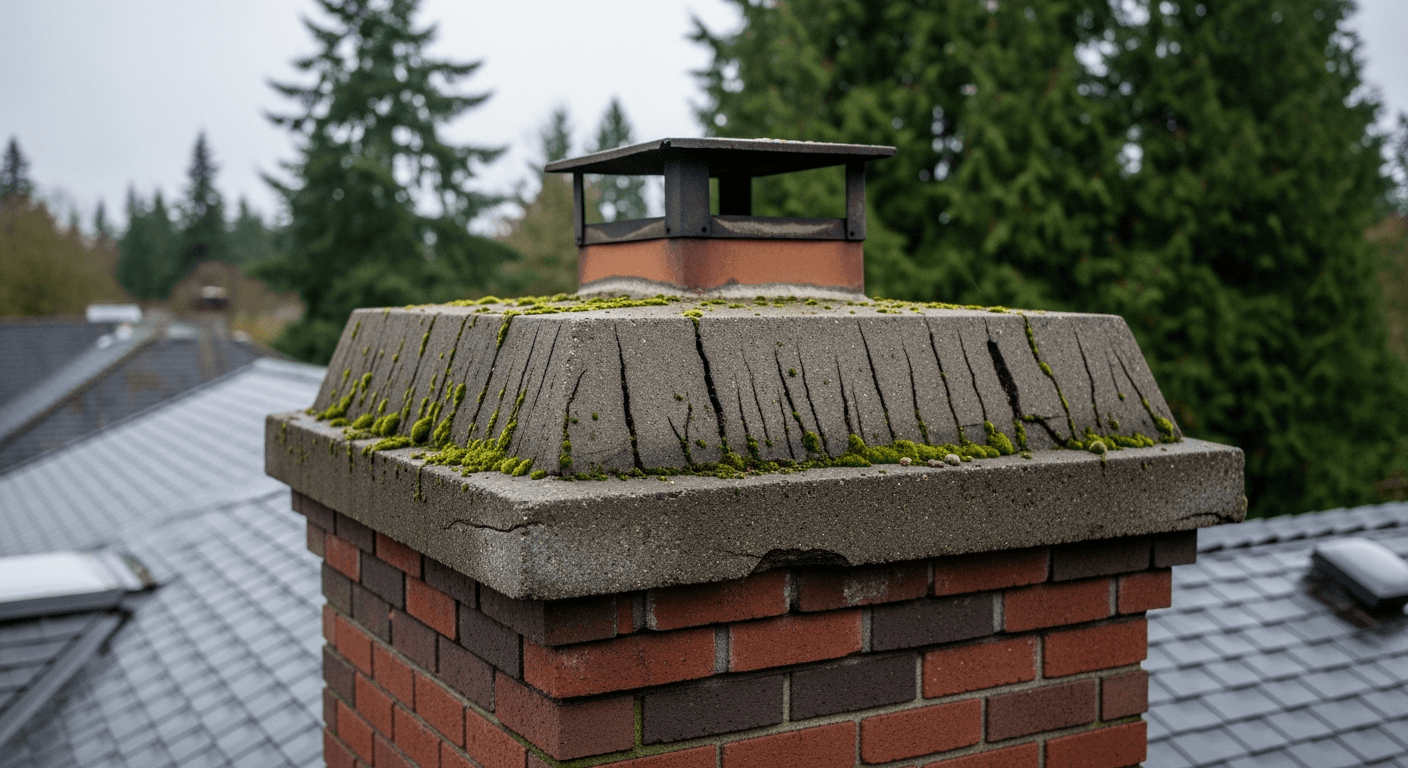
Moss and algae growth on the chimney crown and upper courses are a direct flashing risk factor — not merely a cosmetic issue. Moss retains moisture against mortar joints for days after rain stops, accelerating the micro-cracking that eventually releases embedded flashing edges. North-facing chimneys and those shaded by the large conifers common on Bellevue lots are particularly susceptible. Treating moss at first appearance protects the mortar joints and, by extension, the flashing they anchor.
If your home was built between 1978 and 2000 and has never had its flashing professionally inspected, treat it as overdue regardless of whether you have seen interior moisture. Construction practices and materials from that era — including aluminum flashing, surface-applied tar seals, and step flashing with minimal overlaps — have a well-documented failure profile in Bellevue's climate. A proactive re-flash with galvanized steel now costs a small fraction of what water-damage remediation, attic mold treatment, and framing repair cost after one or two undetected leaking seasons.
Frequently asked questions
How do I know if my chimney leak is a flashing problem or something else?
Chimney flashing failure in Bellevue typically shows as ceiling or wall moisture at the point where the chimney meets the roofline, appearing or worsening during or right after rain. If your roofer finds no damaged shingles and the moisture is not inside the firebox itself, the flashing is the most probable source. A Level 1 chimney inspection with a hands-on flashing check from the roof will confirm it.
Will my homeowners insurance cover chimney flashing repair?
Chimney flashing repair in Bellevue is not typically covered for normal wear and deterioration — insurers classify that as a maintenance issue. If a specific covered event such as a windstorm, falling branch, or hail caused identifiable damage to the flashing, that portion of the repair may be claimable. Photograph the damage before any work begins and contact your insurer to request an adjuster review prior to authorizing repairs.
Can I seal chimney flashing myself with roofing cement?
A tube of flexible polyurethane caulk over a small, intact gap can buy a season as a temporary measure on a Bellevue chimney. Roofing tar or cement is not appropriate — it degrades in UV and cold and cannot bond to metal and mortar simultaneously. Neither product addresses flashing that has physically pulled free from the mortar joint. For any gap wider than a hairline or any flashing that has separated, professional mechanical re-embedment is the only durable fix.
How long does a chimney flashing repair take?
A partial or full re-flash on a standard Bellevue single-family home typically takes three to five hours for a two-person crew. Jobs that require significant shingle removal, mortar repointing, or an attic inspection for moisture damage may extend to a full day. Most chimney flashing repairs in Bellevue are completed in a single scheduled visit.
What flashing material is best for Bellevue's climate?
Copper is the premium specification for longevity in Bellevue and the broader Pacific Northwest — it resists corrosion indefinitely, develops a self-protective patina, and will outlast the masonry it seals. Galvanized steel is a reliable mid-range option with a 15-to-20-year service life when properly installed on a Bellevue home. Aluminum is not used on new installations because of its corrosion risk in contact with the treated lumber and cedar materials common in Eastside construction.
Related services