Yes — cracked firebricks or crumbling mortar joints in your Bellevue fireplace almost always require professional repair, and Bellevue's wet maritime climate makes deterioration faster and more consequential here than in drier regions. Firebox patch repairs in Bellevue run $300–$900, while a full interior rebuild ranges from $1,500 to $4,500 depending on firebox size, damage extent, and access difficulty — and every season you delay typically moves you one tier up that scale.
What exactly is the firebox, and why does it deteriorate faster in Bellevue's climate?
The firebox is the interior brick-lined chamber where the fire burns. It is constructed from refractory firebrick and refractory mortar, both engineered to withstand sustained temperatures above 1,000 °F. Standard brick and mortar would fracture within a single Bellevue burn season under those conditions.
Bellevue's wet maritime winters — averaging over 37 inches of annual rainfall — accelerate firebox deterioration through a mechanism that is specific to this climate. During the long off-season from April through September, moisture penetrates through uncapped flues, aging crown mortar, and deteriorated joint pointing, saturating the refractory masonry. When the fireplace is lit for the first time each autumn, that moisture-laden brick is subjected to rapid, intense heat. The resulting thermal shock causes spalling and through-brick cracking at a rate two to three times faster than what the same fireplace would experience in a drier inland climate. Puget Sound's mild but persistently damp winters compound the problem: the firebox rarely gets hot enough to fully dry out between fires the way it would in a colder, drier region.
Gas insert installations — prevalent in Bellevue's newer construction along the 98004 and 98006 corridors and in renovated mid-century homes throughout Beaux Arts Village — introduce a second deterioration pathway. An improperly sized gas insert or one retrofitted without a correctly rated liner allows acidic combustion condensate to collect on firebox walls, etching refractory mortar joints over multiple seasons. This damage is less visually dramatic than spalling brick but equally serious: it undermines the mortar's ability to contain combustion gases and maintain safe draft geometry.
How do you know if your firebox needs repair, a partial rebuild, or a complete rebuild?
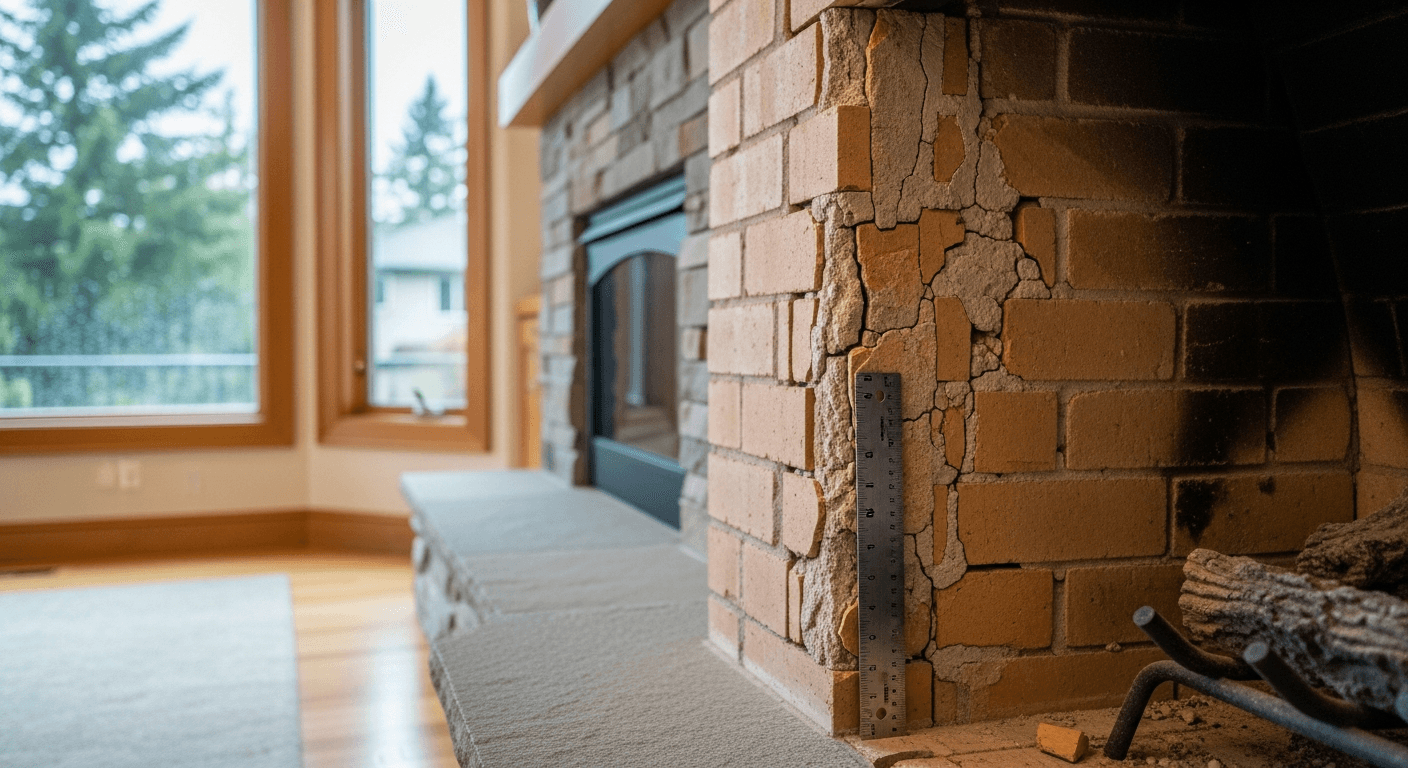
Hairline mortar joint cracks narrower than 1/8 inch confined to the lower side walls are typically candidates for refractory repointing — the least expensive intervention, generally $300–$600 in Bellevue's 2025 market. Cracks wider than 1/4 inch, any crack that runs through the face of a firebrick rather than stopping at the mortar joint, or any cracking at or above the throat and smoke shelf elevation indicates structural compromise that repointing alone cannot address.
A partial rebuild — tearing out and relaying one damaged wall section — is appropriate when deterioration is concentrated in a discrete area while the surrounding masonry remains structurally sound and the firebox geometry still meets Washington State's adopted version of NFPA 211 dimensional requirements for safe draft. A full interior rebuild is warranted when two or more walls are compromised, when the smoke shelf has partially collapsed, or when a Level 2 camera inspection reveals that the firebox opening-to-flue-area ratio has drifted out of compliant range — a situation we see in older Bellevue homes where decades of patch-over-patch repairs have altered the original geometry.
One locally relevant warning sign that Bellevue homeowners frequently attribute to other causes: if you detect smoke in the room while burning with the damper fully open, do not assume it is a drafting quirk caused by Bellevue's hillside topography or neighboring tree canopy. A partially collapsed smoke shelf is a leading cause of that symptom, and it routes combustion gases — including carbon monoxide — directly into the living space. That condition requires immediate professional evaluation, not a temporary fix.
Firebox repair and rebuild cost breakdown for Bellevue, WA homeowners
The table below reflects current pricing in the Bellevue and greater Eastside market as of 2025. Costs vary with firebox dimensions, access constraints, and whether a Level 2 inspection is bundled. Large masonry fireplaces — standard in estate homes on Clyde Hill, Medina, and Bellevue's Somerset plateau — occupy the upper end of each range. Smaller prefabricated-masonry fireplaces common in 1980s–1990s construction in Factoria and Newport Hills typically fall toward the lower end.
A scheduling consideration specific to Bellevue: the Puget Sound Clean Air Agency enforces wood-burning curtailment days during stagnant-air episodes, typically concentrated between November and February. Homeowners who want their fireplace fully operational from the first cold snap in early October should book a firebox assessment in August or September — before the autumn rush and before the first curtailment period limits burn-season testing.
The estimates below assume the flue liner, chimney crown, and cap are in serviceable condition. Liner relining or crown repair, when needed, is scoped and priced as a separate line item after the Level 2 inspection defines the full scope of work.
| Service | What It Covers | Typical Cost Range (Bellevue, 2025) |
|---|---|---|
| Refractory mortar joint repointing | Re-tuck deteriorated joints between firebricks, lower firebox walls | $300 – $600 |
| Individual firebrick replacement | Remove and reset cracked or spalled firebricks (per brick, materials and labor) | $50 – $120 per brick |
| Firebox floor (hearth bed) repair | Relay or patch the firebox floor with code-compliant refractory materials | $400 – $800 |
| Partial firebox rebuild (one wall) | Tear out and rebuild one deteriorated wall section to original geometry | $700 – $1,500 |
| Full interior firebox rebuild | Complete tear-out and rebuild of all interior firebox walls and floor | $1,500 – $4,500 |
| Smoke shelf repair or reconstruction | Rebuild a collapsed or heavily deteriorated smoke shelf to restore safe draft | $600 – $1,400 |
| Pre-repair Level 2 inspection (bundled) | Camera inspection of firebox and full flue to define damage scope before work begins | $200 – $350 |
A Bellevue homeowner's firebox repair story: what started as 'a few cracks'
A homeowner in Bellevue's Somerset neighborhood called us in late September, weeks before she planned to light her first fire of the season. She described 'a few hairline cracks' in the rear wall of her large double-opening masonry fireplace — original to the home, built in 1988. She had been burning wood two or three evenings a week each winter for years and had treated the cracks as cosmetic.
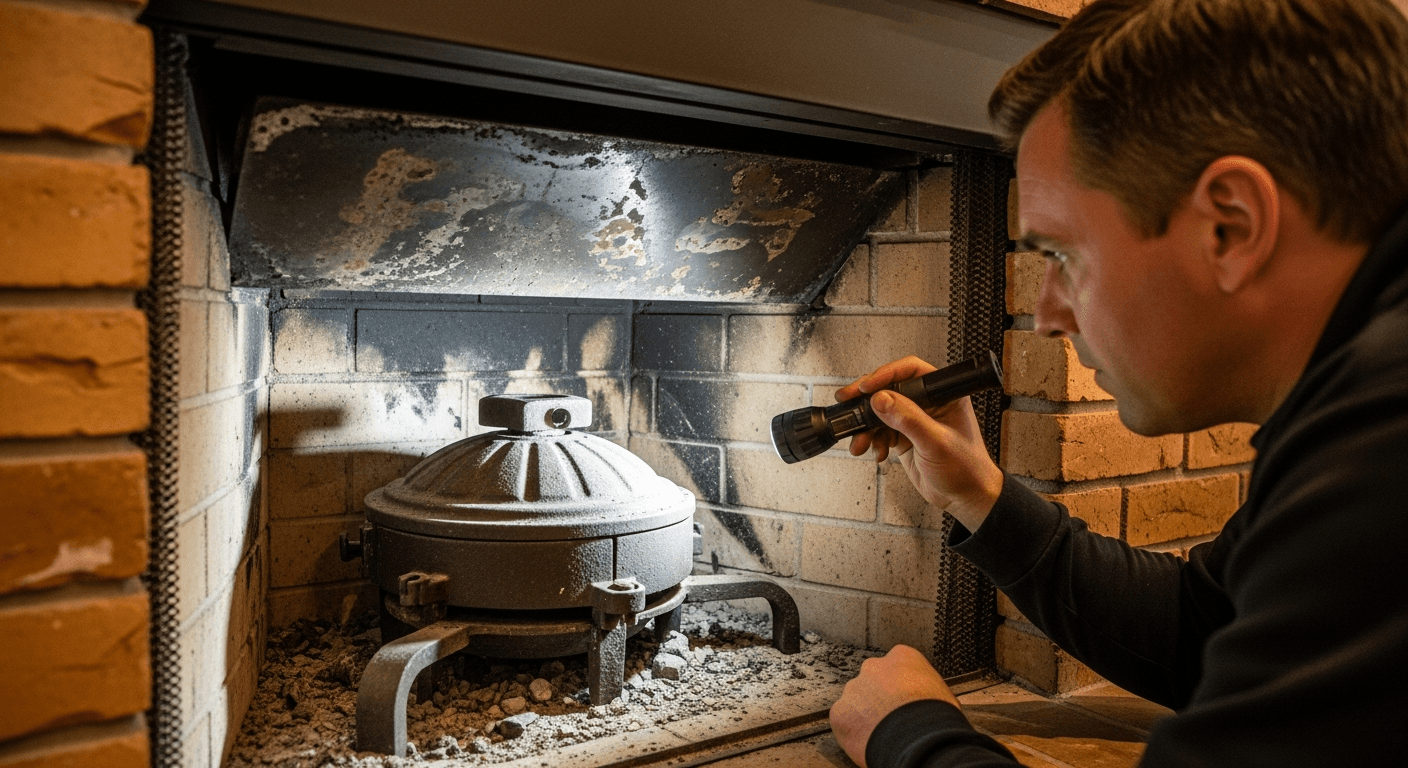
Our technician's pre-repair inspection told a different story. What appeared to be hairline cracks from inside the firebox were full-thickness fractures through four firebricks on the rear wall — their true width masked by a heavy layer of surface soot. The smoke shelf had partially collapsed on the left side, which explained the intermittent smoke odor she had been attributing to wind-driven backdrafting. The firebox floor had also settled unevenly, fracturing three additional bricks along its centerline. A separate liner scope confirmed the clay tile liner was intact and did not require relining.
The repair scope became a partial rear-wall rebuild, smoke shelf reconstruction, and full firebox floor relay — completed before October and totaling $2,760. Had she burned through one more winter with the rear wall in that condition, combustion gases could have reached the stud framing behind the firebox — a scenario that would have required a full firebox rebuild, potentially a liner assessment under a mandatory Level 3 inspection, and structural framing repair. The early call kept the project within the partial-rebuild tier and, more consequentially, kept her family safe through the burn season.
Can you use your fireplace while waiting for firebox repairs — and will homeowners insurance cover the work?
Do not use a fireplace with cracks wider than 1/8 inch, missing mortar, or visibly spalled firebricks. Combustion gases, including carbon monoxide, can migrate through compromised masonry into wall cavities and living spaces before any visible smoke signal alerts you. Heat transfer through cracked refractory brick can also reach combustible framing — a direct fire-hazard pathway. If you have a gas insert and the firebox shows only surface crazing without structural cracking, your chimney professional can assess whether continued gas use is safe pending scheduled repairs. Do not make that judgment independently.
On insurance: standard homeowners policies in Washington State do not cover firebox deterioration from deferred maintenance or normal service wear. Coverage may apply when a sudden, documented event — a chimney fire, a lightning strike confirmed by a weather service record, or a windstorm that displaced the crown — caused or materially accelerated the damage. If you believe an event triggered your firebox damage, photograph everything before touching it, notify your insurer before any repair work begins, and request a written cause-and-extent assessment from your chimney professional. Insurance adjusters require clear documentation of both the precipitating event and the resulting damage to evaluate a claim; a technician's written report is the most useful supporting document you can provide.
NFPA 211 — the national standard governing chimney inspection and maintenance, adopted as the reference standard in Washington State — recommends at minimum one professional inspection per year for any fireplace in active use. For Bellevue wood-burning fireplaces that see regular use through a wet five-month season, a sweep at the close of burn season in March and a pre-season inspection in August or September is the schedule that catches deterioration while it is still in the $300–$600 repointing tier — rather than the $2,500–$4,500 rebuild tier.
Frequently asked questions
How often should I have my Bellevue fireplace's firebox inspected?
NFPA 211 requires at minimum one professional inspection per year for any fireplace in active use. For Bellevue homeowners burning wood regularly through the November–March season, the most effective schedule is a sweep and Level 1 inspection at the end of burn season (March or April) and a pre-season Level 1 or Level 2 inspection in August or September. Bellevue's wet climate accelerates mortar joint deterioration during the off-season, so the pre-season check is particularly valuable for catching moisture damage before the first fire of autumn.
Will homeowners insurance cover firebox repair in Bellevue?
Not for normal wear or deferred maintenance — standard Washington State homeowners policies exclude that. If a sudden event such as a chimney fire or a documented storm caused the damage, coverage may apply. Photograph all damage immediately, contact your insurer before repairs begin, and ask your chimney professional for a written assessment describing the cause and extent of damage. That report is the key document your adjuster will need to evaluate the claim.
What does a Level 2 chimney inspection cost in Bellevue, and is it necessary before firebox repairs?
A Level 2 inspection in Bellevue costs $250–$400 and includes a camera scan of the full flue and firebox interior. It is strongly recommended before any firebox repair or rebuild because it reveals hidden fractures, liner damage, and geometry changes that a visual inspection cannot detect. Proceeding with repairs without a Level 2 inspection risks missing adjacent damage that will resurface — at higher cost — within one or two burn seasons.
Can I patch firebox cracks myself with hardware-store products?
Consumer refractory patching compounds are appropriate only for hairline surface crazing in mortar joints — nothing structural. Any crack wider than 1/8 inch, any crack through the face of a firebrick (not just the mortar), or any symptom of smoke entering the room requires a professional assessment before any repair is attempted. Patching a structural crack incorrectly masks a hazard without correcting it, and doing so may complicate a subsequent insurance claim if the damage worsens.
How do I know whether my firebox needs repair or a full rebuild?
The decision hinges on crack width, crack location, and how many firebox surfaces are affected. Hairline mortar joint cracks under 1/8 inch in the lower sidewalls are typically repairable with repointing. Cracks through firebrick faces, cracks at the throat or smoke shelf elevation, or damage spanning more than one wall generally indicate a partial or full rebuild. A Level 2 inspection gives you a definitive answer based on camera evidence rather than guesswork — and in Bellevue's 2025 market, that $250–$400 inspection routinely prevents homeowners from either over-investing in an unnecessary full rebuild or under-investing in a patch that won't hold.
Related services