Yes — a chimney damper that won't seal fully is actively costing you money and letting Bellevue's wet winter air into your flue every day it goes unfixed. Repairing or replacing a throat damper typically runs $150 to $550; a top-mount damper installed above the flue costs $200 to $700, and most jobs are finished in a single visit. Knowing which damper type you have, what's driving the failure, and whether repair or full replacement makes economic sense are the three decisions that will protect both your heating budget and the long-term integrity of your masonry chimney.
Why Damper Problems Are Especially Common in Bellevue Homes
Bellevue averages roughly 37 inches of rain per year, and the bulk of it falls as persistent drizzle from October through March — not heavy downpours that drain quickly, but sustained damp air that cycles in and out of an open flue for five straight months. Traditional cast-iron throat dampers, which sit just above the firebox, are the first components to show the damage. The daily temperature swing between a heated firebox at 400°F and a cold exterior flue at near-freezing gradually warps the damper plate and corrodes the pivot hardware until the plate no longer sits flush in its frame.
Many higher-end homes in neighborhoods like Clyde Hill, Enatai, and West Bellevue were built with generously proportioned masonry chimneys that create a large cold-air column in winter. Even a slightly warped throat damper allows that column of 35°F air to cascade into the living room. Homeowners typically notice this as a persistent cold draft near the firebox, heating bills that creep upward from November through February, or a faint musty smell indicating moisture is working its way down the flue lining.
Gas fireplace inserts — common in Bellevue's newer custom builds and remodeled mid-century Craftsman properties — present a specific damper problem. Most insert installations require the throat damper to be permanently propped open or removed entirely, leaving the flue as an open pipe to the exterior whenever the fire isn't running. A properly installed top-mount damper that seals from above is the only way to recover draft control and weatherproofing in that configuration.
Signs Your Damper Needs Attention Right Now
The clearest sign is a handle or chain that moves freely but produces no noticeable change in draft. A properly sealed damper should nearly eliminate airflow when you hold your palm near the firebox opening. If you still feel cold air entering with the damper closed, the plate is warped, the pivot has shifted, or the gasket has failed — and the problem will worsen through the heating season, not improve on its own.
A visible rust bloom on the damper plate or pivot frame — something our technicians identify during a Level 1 inspection — indicates active corrosion on both the exposed and hidden surfaces of the mechanism. At that stage, the pivot pins can seize without warning, leaving the damper stuck open heading into the wettest part of the Bellevue winter. Rust staining on the firebox floor directly below the damper plate is a visual cue you can check yourself before calling.
Soot or fine debris falling onto a closed damper plate points to a gap or warp in the plate itself. On Puget Sound Clean Air Agency mandatory no-burn days — which are triggered by air quality conditions that regularly affect the Eastside between November and February — a poorly sealing damper lets residual smoke odors migrate back into the home even days after the last fire, because the flue never fully closes. A top-mount damper with a silicone or rubber perimeter gasket is the most effective solution for that specific problem.
Repair vs. Replacement: What the Work Actually Involves and What It Costs
Minor repairs — lubricating a stiff pivot, straightening a bent handle rod, or reseating a plate that has shifted off its ledge — are low-cost fixes a technician can often complete during the same appointment as a chimney sweep. These repairs make sense when the damper plate itself is intact and the frame shows no significant warping or active rust pitting.
Full replacement becomes the right call when the plate is warped enough that no adjustment produces a reliable seal, when the pivot pins are seized and cannot be freed without risking the surrounding masonry, or when the homeowner is retiring a throat damper in favor of a top-mount model. Top-mount dampers are increasingly the preferred solution for Bellevue homes because sealing at the crown — rather than at the throat — keeps the entire flue interior warmer and drier, which reduces creosote glazing in cold weather and slows mortar deterioration in the smoke chamber above.
The table below reflects typical cost ranges for damper work on Bellevue-area masonry chimneys. Labor is the primary variable; chimneys with deep smoke chambers or offset flues may require additional time. These figures cover the damper work only and do not include any chimney sweep or inspection fees, which are quoted separately.
| Service | Typical Cost Range | Average Completion Time | Best For |
|---|---|---|---|
| Damper lubrication and adjustment | $75 – $150 | 30–45 minutes | Minor stiffness; handle still functional |
| Throat damper repair (hardware replacement) | $150 – $275 | 1–2 hours | Worn pivot pins or broken handle rod |
| Throat damper full replacement | $250 – $550 | 2–3 hours | Warped or heavily corroded plate |
| Top-mount damper installation (new) | $200 – $700 | 1–2 hours | Gas inserts, chronic draft issues, poor sealing |
| Top-mount damper replacement (existing) | $150 – $400 | 1 hour | Failed gasket, broken cable or chain |
| Smoke chamber repair alongside damper work | $300 – $900 additional | Half to full day | Spalling or open mortar joints above the damper |
Common Damper Symptoms and Their Most Likely Causes
Damper problems in Bellevue chimneys tend to follow recognizable patterns. The symptom a homeowner notices — a cold draft, a stuck handle, a smoke odor — usually points to one of a small number of underlying causes. The table below maps the most common symptoms to their probable causes and the typical service response, so you can describe the problem accurately when you call and understand the technician's recommendation when it arrives.
Note that multiple symptoms occurring together — for example, a stuck handle combined with rust staining on the firebox floor — generally indicate that more than one component has failed simultaneously, which shifts the repair-versus-replace calculation toward full replacement rather than targeted repair.
| Symptom Observed | Most Likely Cause | Typical Service Response |
|---|---|---|
| Cold air draft with damper fully closed | Warped plate or failed gasket no longer seating flush | Throat damper replacement or top-mount damper installation |
| Handle or chain moves but draft doesn't change | Pivot pins seized or handle rod disconnected from plate | Hardware repair or full damper replacement |
| Rust staining on firebox floor below damper | Active corrosion on plate or pivot frame; moisture intrusion | Inspection to assess extent; replacement if pitting is deep |
| Smoke or odor entering home with damper closed | Gap in plate warp or gasket failure allowing back-draft | Top-mount damper with perimeter gasket recommended |
| Debris or soot falling onto closed damper | Plate warp creating gap; no longer blocking flue opening | Plate replacement; check smoke chamber for spalling |
| Damper stuck open and will not close | Seized pivot pins or warped plate jamming in frame | Hardware freed if possible; full replacement if masonry at risk |
| Damper stuck closed and will not open | Corrosion welding pivot to frame over dormant season | Lubrication attempt first; replacement if pivot cannot be freed |
| Musty or damp smell near fireplace | Moisture condensing inside flue on cold damper plate | Top-mount damper to seal flue from crown; flue liner inspection |
A Bellevue Homeowner Discovered the Problem During a Routine Sweep
Consider a hypothetical but representative scenario: a homeowner in Bellevue's Clyde Hill neighborhood calls in late October after noticing heating bills have risen gradually over two winters — not dramatically, but enough to prompt questions. They use a large masonry wood-burning fireplace four or five times a season and assume the damper is functional because the handle still moves by hand.
During the sweep, the technician finds a throat damper plate with a visible warp across its center — a gap large enough that daylight is visible around the plate edges when closed. The pivot hardware shows heavy rust consistent with several summers of moisture cycling through the flue unchecked. The homeowner has been leaving the equivalent of a two-inch-wide opening to the cold exterior air through at least two full heating seasons.
Rather than replace the throat damper in kind, the recommended solution is a top-mount damper installation. Because the fireplace is used only occasionally, sealing from the crown means the entire masonry flue stays drier between fires, reducing efflorescence risk on the exterior chimney and slowing future mortar deterioration in the smoke chamber. Installation is completed the same day as the sweep, and within the first week of sustained cool weather the improvement in comfort near the fireplace wall is noticeable — a common outcome for Bellevue homes where a warped throat damper has been leaking cold air undetected for multiple seasons.
Throat Damper vs. Top-Mount Damper: Which Is Right for Your Bellevue Chimney?
Throat dampers are built into the masonry of most Bellevue chimneys constructed before the mid-2000s. They are straightforward to operate and fully adequate when in sound condition. If your throat damper plate is not warped and the pivot hardware is intact, replacing it in kind is the most cost-effective path — no roof access required, and the firebox geometry is already matched to a throat-mount unit.
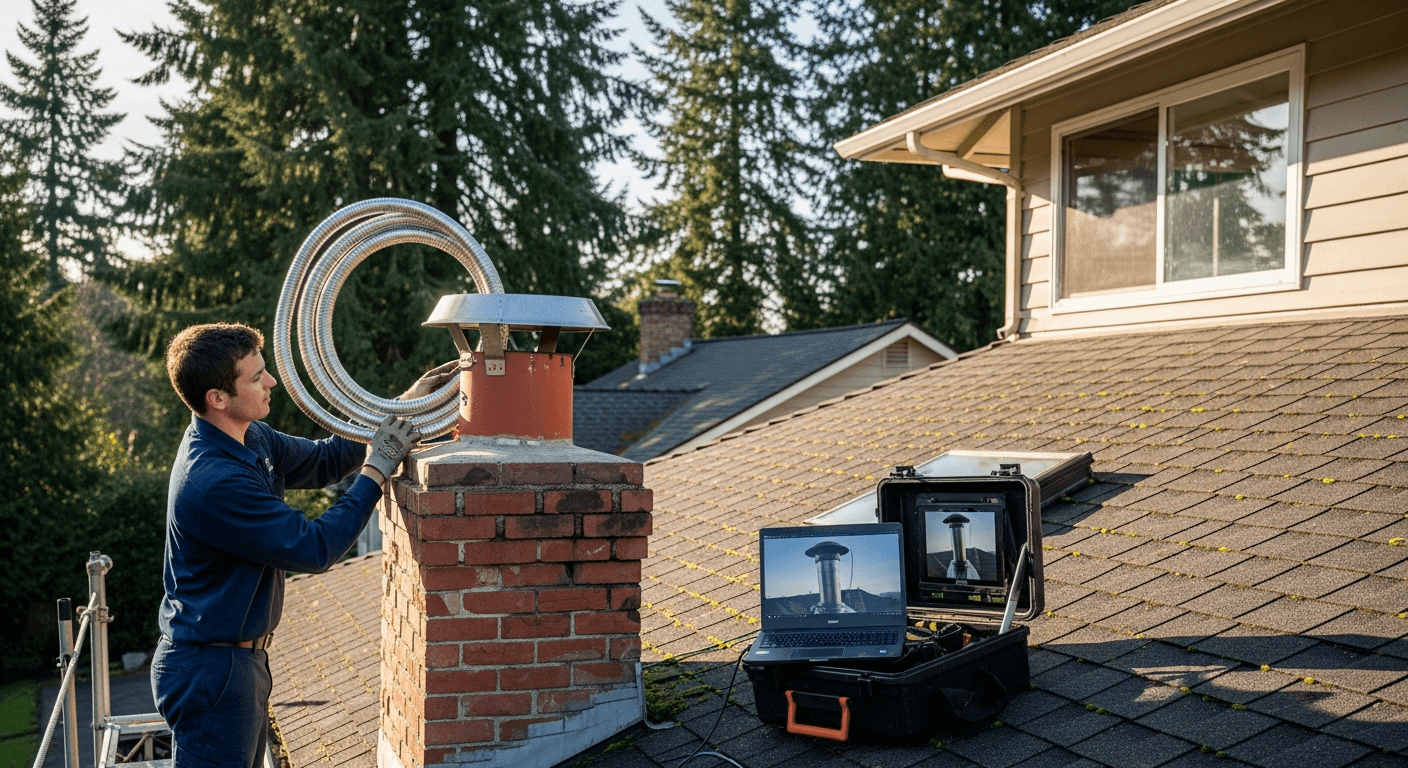
Top-mount dampers, mounted at the crown and operated by a stainless steel cable that runs down the flue to a pull-ring inside the firebox, offer two advantages that matter specifically in Bellevue's climate. First, a sealed flue from the top prevents the entire length of the flue tile from acting as a condensation surface during cold, damp weather — a direct cause of accelerated mortar deterioration in the smoke chamber. Second, a top-mount damper doubles as a chimney cap, blocking the birds, squirrels, and moss debris that wash off Eastside rooflines during heavy rain from entering the flue.
Gas insert owners should confirm with their technician that the top-mount model selected is rated for use with gas appliances. Gasket materials and minimum clearance specifications differ between wood-burning and gas-rated units, and installing the wrong type can void the appliance manufacturer's warranty and create a safety noncompliance issue.
When to Schedule Damper Service in Bellevue
The optimal window for damper inspection and repair in Bellevue is August through mid-October — after the dry summer has allowed residual flue moisture to dissipate and before November's sustained rain locks in. Scheduling during this window means shorter wait times and gives any mortar work around a new damper frame adequate cure time — typically 28 days for refractory mortar — before temperatures drop below freezing overnight.
If you are already in the heating season and are experiencing a noticeable draft or a damper that won't hold position, do not postpone the repair. A stuck-open damper creates a persistent negative pressure pathway in the home's air envelope. In some configurations — particularly homes where a gas furnace or water heater shares a mechanical room with limited makeup air — that pathway can encourage carbon monoxide to back-draft from combustion appliances. That safety risk outweighs the inconvenience of a mid-winter service call.
Damper condition is evaluated as part of every Level 1 and Level 2 inspection we perform. If it has been more than two years since your chimney was last professionally inspected, a combined inspection and sweep is the most cost-efficient way to assess the damper alongside the chimney crown, flue liner, and firebox before the peak of burn season.
Frequently asked questions
How do I know if my chimney damper is fully closed?
Hold your open palm near the firebox opening with the damper closed. A properly sealed damper in a Bellevue masonry chimney produces no perceptible draft. For a more sensitive test, hold a lit match just inside the firebox — if the flame bends toward the room, cold air is entering and the seal has failed. In Bellevue masonry chimneys during winter, even a small warp in the plate creates a detectable cold spot along the wall near the firebox within a few hours.
How often does a chimney damper need to be inspected?
Annually, as part of the Level 1 inspection that NFPA 211 recommends for any chimney in regular use. In Bellevue's wet climate, a chimney used only a few times per season can still show meaningful corrosion and warping within two to three years if moisture is present in the flue. Annual inspections catch early-stage issues when a $75 to $150 adjustment is still all that's needed, rather than a full replacement.
Can I replace a chimney damper myself?
Throat damper replacement in a Bellevue masonry chimney requires working inside the firebox, removing the old unit without cracking the surrounding masonry, and fitting the new plate to the specific smoke shelf geometry of that chimney — dimensions that vary considerably in older Bellevue masonry construction. Top-mount installation requires safe roof access and a weathertight seal at the crown. Both jobs are technically within reach for experienced DIYers, but a poor fit creates draft problems worse than the original failure, and neither job comes with the smoke chamber inspection that a professional visit includes — which is where the underlying moisture damage is most often found.
Will homeowners insurance cover a damper replacement?
Standard policies cover sudden, accidental damage — for example, a falling branch that destroys a top-mount damper during a windstorm. Gradual corrosion and moisture-related wear, which account for the majority of damper failures in Bellevue, are typically excluded as maintenance issues. Photograph the damage before any work begins and review your policy's 'sudden and accidental' versus 'wear and tear' language carefully. Some extended structure riders offer broader coverage, so a call to your insurer before scheduling repairs takes only a few minutes and could matter.
What does a combined chimney sweep and damper check cost in Bellevue?
A standard chimney sweep with a Level 1 inspection — covering damper condition, firebox, accessible flue, and exterior crown — typically runs $175 to $325 in Bellevue, depending on flue height, roof pitch, and creosote load. If a damper adjustment or minor repair is identified and completed at the same appointment, expect an additional $75 to $150 for that labor. A full damper replacement discovered during the visit is priced separately per the ranges in the cost table above.
Related services