Yes — every chimney on a Bellevue home needs a cap, and if yours is missing or damaged, your flue is open to rain and wildlife right now. Bellevue averages 38 inches of rain annually, nearly all of it driven sideways by southwest winds from October through March; an uncapped masonry chimney channels that moisture directly into the flue tile, where it erodes mortar joints, spalls liner segments, and rusts the throat damper — repairs that routinely cost ten to twenty times more than a replacement cap. Whether you have a full masonry fireplace in a 1990s Somerset craftsman or a gas insert with a dedicated stainless liner in a newer Clyde Hill home, the right cap keeps your system dry, wildlife-free, and compliant with Puget Sound Clean Air Agency spark-arrestor rules for wood-burning appliances.
What exactly does a chimney cap do — and why does Bellevue's climate make it non-negotiable?
A chimney cap is a metal cover — stainless steel, galvanized steel, or copper — that sits over the flue opening at the crown. It has three functions: block rain and windblown debris from entering the flue, exclude nesting wildlife, and arrest burning embers before they reach cedar shake roofs or neighboring yards.
Bellevue's 38 inches of annual rainfall arrives in long, saturating stretches from October through March. Without a cap, a masonry chimney acts as a funnel: water pools in the smoke chamber, penetrates mortar joints, and freezes in overnight cold snaps that regularly drop below 32°F on the Plateau. Two or three wet seasons of this cycle cause liner segments to spall and the steel throat damper to seize — each repair running $400–$2,000 or more, versus a $200–$350 stainless cap installed today.
Debris is an equal threat in tree-heavy neighborhoods like Newport Hills, Somerset, and Cougar Mountain. Douglas fir needles, big-leaf maple seeds, and small twigs compact into a dense plug inside an uncapped flue within a single fall season, restricting draft and pushing carbon monoxide back into living spaces. A properly meshed cap stops accumulation while maintaining the airflow a healthy draft requires.
Gas insert owners face a distinct but equally serious risk: condensation from flue gases pools inside a stainless liner that lacks a cap, corroding the liner from the inside out. Because insert liners are sized precisely to the appliance's BTU rating — a mismatch voids both the liner warranty and the appliance warranty — even pinhole corrosion can require a full relining at $1,500–$3,000.
What types of chimney caps are available, and which is right for your Bellevue home?
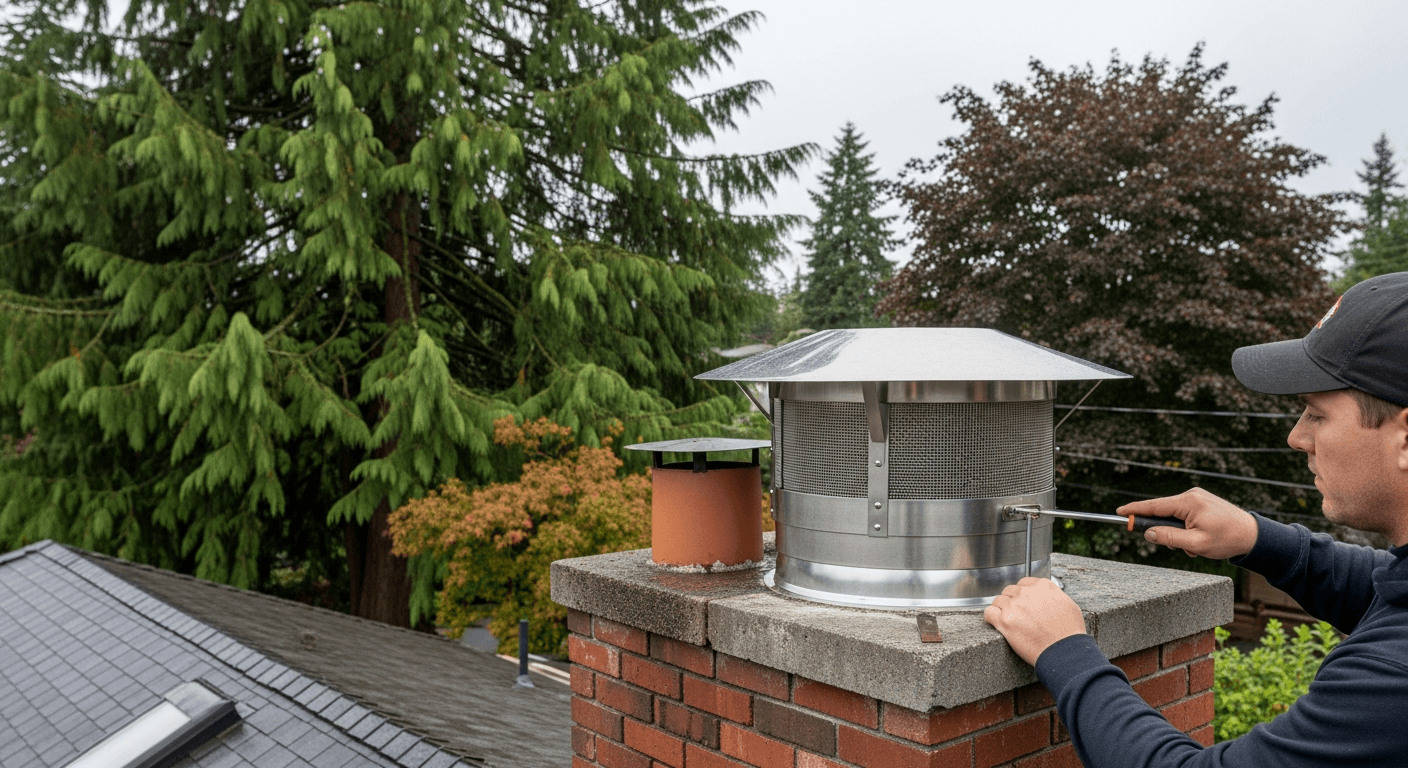
Single-flue caps cover one flue tile and are the standard choice for most Bellevue homes with a single wood-burning or gas fireplace. They clamp to the outside of the clay flue tile with set screws and are available in 304 stainless steel, 316 stainless steel (better corrosion resistance for homes closer to Lake Washington's salt-influenced air), galvanized steel, or copper. On high-visibility chimneys in Medina or Clyde Hill, copper caps develop a patina that complements brick and natural stone — a finish some local architects specify by material and gauge.
Multi-flue caps, also called top-mount or outside-mount caps, cover the entire chimney crown rather than individual tiles. They are the correct solution when two or more flues share one chimney — common in larger Bellevue homes where a wood fireplace and a gas furnace or water-heater vent share the same masonry chase. A single top-mount cap eliminates the gap between individual caps, protects the full crown surface from water infiltration, and simplifies annual inspection.
Draft-boosting caps use a directional shroud or turbine to increase draw on chimneys with persistent downdraft problems — typically ranchers or split-levels in Bellevue's hillside lots where the chimney barely clears the roofline. These are a targeted solution for a confirmed draft deficit, not a routine recommendation; the underlying cause should be diagnosed before selecting this style.
Gas insert liner caps must match the liner's inner diameter exactly — 3-inch, 4-inch, 5-inch, or 6-inch depending on the appliance's BTU output and venting configuration. An oversized cap leaves an annular gap that allows moisture ingress and defeats the condensation barrier. Always verify cap specification against the insert's installation manual, or have a technician confirm the liner diameter on-roof before ordering.
How much does chimney cap installation cost in Bellevue? (Price table by cap type)
Cap pricing in Bellevue varies by material, size, and roof access complexity. All figures below are installed prices — parts plus labor — for a standard one- or two-story Eastside home with a walkable or moderately pitched roof. Steeply pitched roofs common in Bellevue's hillside lots, or three-story homes, typically carry a $75–$150 access surcharge due to additional rigging time and safety equipment.
Galvanized steel caps are the entry-level option. In Bellevue's marine air — influenced by moisture off Lake Washington and Puget Sound — galvanized mesh oxidizes and becomes brittle within five to eight years, eventually opening gaps wide enough for starlings and squirrels. Stainless steel is the practical choice for most homeowners: it resists the region's salt-influenced humidity, requires no special maintenance, and carries a realistic 20-plus-year service life. Copper is a longevity and aesthetics investment — a properly fabricated copper cap is essentially a lifetime fixture and will outlast the chimney crown beneath it.
If your existing cap blew off in a windstorm but is undamaged, reinstallation runs $75–$125 — a service call plus new stainless set screws. If the crown is cracked and needs patching before the cap can be re-seated, that repair is billed separately but is routinely discounted when completed in the same mobilization as the cap work.
| Cap Type | Material | Estimated Installed Price | Expected Lifespan in Bellevue |
|---|---|---|---|
| Single-flue cap | Galvanized steel | $150 – $220 | 5 – 8 years |
| Single-flue cap | 304 stainless steel | $220 – $350 | 20 + years |
| Single-flue cap | 316 stainless steel | $270 – $400 | 25 + years |
| Single-flue cap | Copper | $350 – $550 | Lifetime (40 + years) |
| Multi-flue / top-mount cap | Stainless steel | $320 – $600 | 20 + years |
| Multi-flue / top-mount cap | Copper | $500 – $900 | Lifetime (40 + years) |
| Gas insert liner cap (4"–6") | Stainless steel | $150 – $280 | 15 – 20 years |
| Reinstallation of existing cap | N/A | $75 – $125 | Depends on cap age |
Warning signs and how often Bellevue homeowners should replace or inspect their chimney cap
Knowing when to act is as important as knowing what to buy. The table below maps common situations Bellevue homeowners encounter to the recommended inspection or replacement frequency, so you can plan maintenance before a missing or failed cap causes expensive secondary damage.
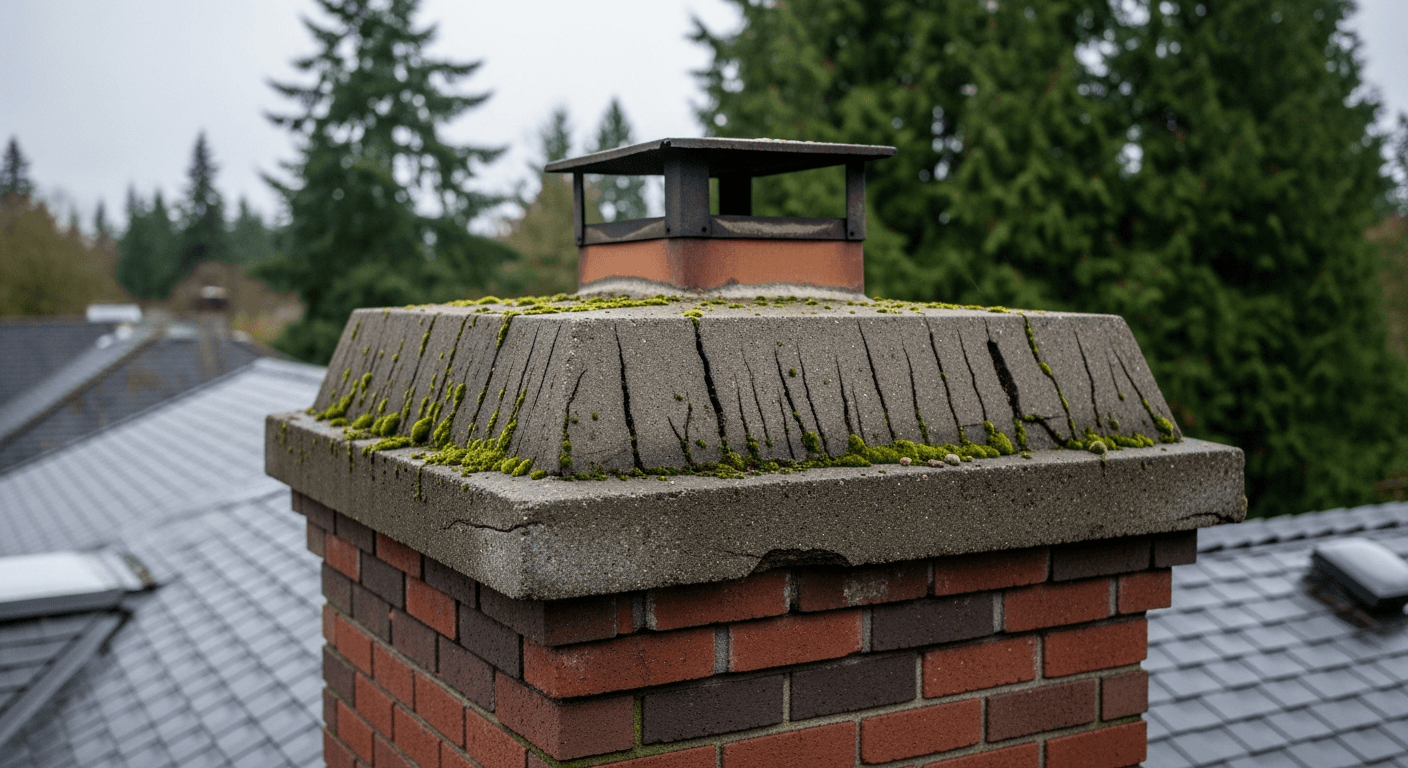
Caps should be inspected every September, before the first fires of the season. The three most common failure modes on Bellevue chimneys are mesh rust-out — the screen turns brittle and opens gaps large enough for birds within a season or two of visible oxidation; crown separation — the mounting collar works loose, allowing the cap to tilt and admit rain around the base; and flat-top seam failure on galvanized models, where the top plate rusts through and allows pinhole water entry that is invisible from the ground.
Two ground-level warning signs require immediate action. First: orange-brown rust streaks running down the chimney exterior from the cap base mean the cap is actively corroding and depositing iron-oxide sediment into the flue — replace now. Second: the sound of rain striking directly inside the firebox rather than a muffled patter on a cap above means water is bypassing the cap entirely, either because the cap is off or the mesh has corroded fully open — replace now.
Burn ban days issued by the Puget Sound Clean Air Agency — which occur several times each winter during Puget Sound's stagnant-air advisories — create a natural maintenance window. Scheduling cap replacement in early November, between the season's first fires and its first prolonged stagnant-air period, avoids any interruption to fireplace use and keeps the flue protected through the wettest months of the year.
Galvanized caps on homes built before 2005 are almost certainly past their service life regardless of outward appearance. The internal mesh corrodes before the outer shell shows obvious rust, so a cap can look intact while providing no meaningful wildlife or spark protection. If you cannot confirm when your current cap was installed, budget for a stainless replacement at this season's inspection rather than waiting for visible failure.
| Situation or Warning Sign | Recommended Action | Suggested Frequency / Timing |
|---|---|---|
| Standard Bellevue home with a stainless or copper cap, no visible damage | Visual inspection from ground level plus rooftop check | Once per year, every September before heating season |
| Galvanized cap installed before 2005, age unknown | Full replacement with stainless steel cap | Immediately — do not wait for visible failure |
| Orange-brown rust streaks on chimney exterior below cap base | Cap replacement plus flue sweep to remove iron-oxide debris | Immediately upon observation |
| Rain audible striking firebox interior rather than muffled patter on cap | Emergency inspection and cap replacement or reinstallation | Immediately — flue is fully exposed to rain |
| Cap displaced by windstorm but cap body undamaged | Reinstallation with new stainless set screws | Within one week; Bellevue rain season begins in October |
| Scratching or animal sounds behind fireplace | CCTV flue inspection, sweep, sanitization, then cap replacement | Immediately — nest material blocks draft and creates CO risk |
| Home located near Lake Washington or Puget Sound shoreline (salt-influenced air) | Upgrade to 316 stainless or copper cap at next inspection | At replacement interval or after any storm damage |
| Draft-boosting cap installed for downdraft issues | Confirm root cause resolved; inspect cap shroud or turbine for debris | Every September and after any major windstorm |
A Bellevue homeowner scenario: the raccoon nest that a $250 cap would have prevented
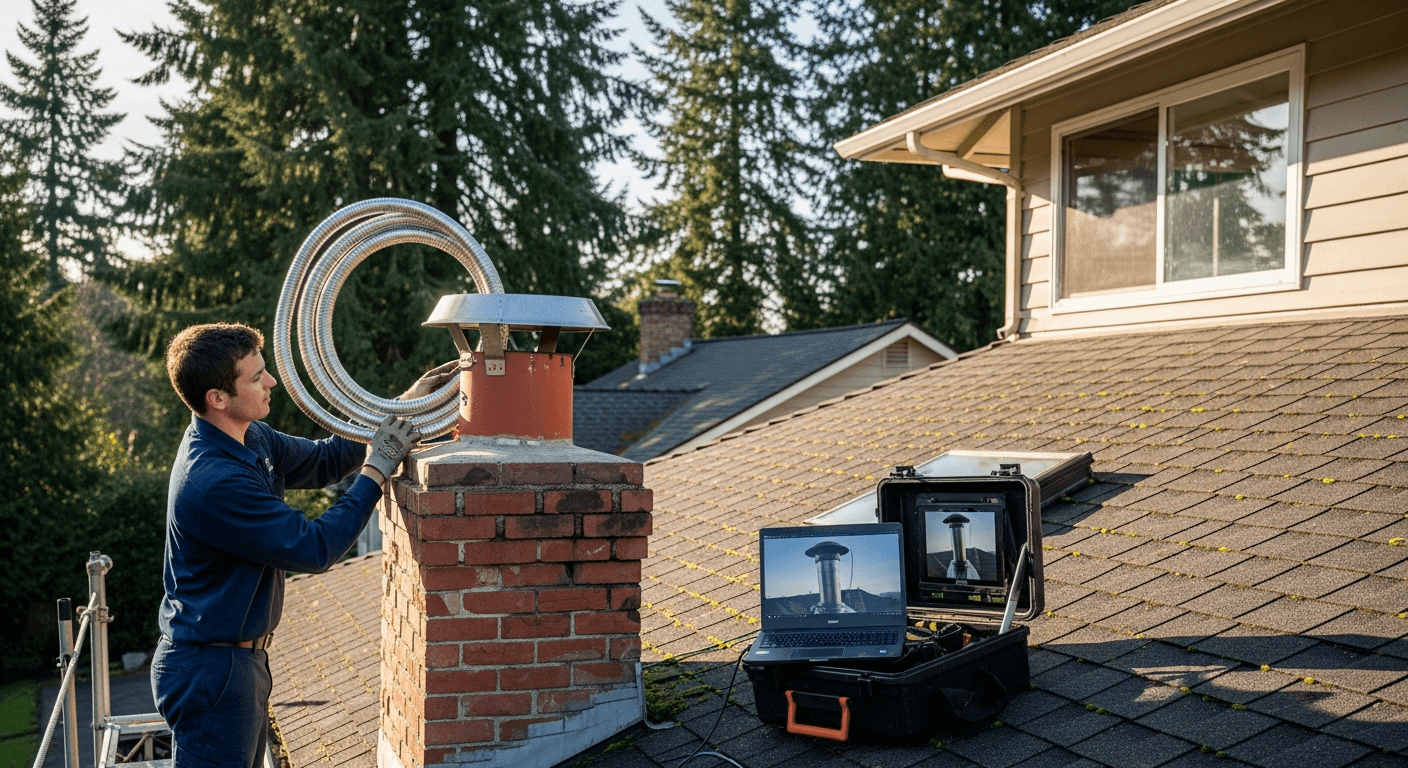
Consider a hypothetical but representative scenario: a homeowner in Somerset calls in late October after noticing scratching sounds behind the living room fireplace. The home — a well-maintained 1987 two-story with a full masonry chimney — has been missing its cap for an unknown period, most likely since a windstorm the prior January. A CCTV camera inspection reveals an adult raccoon nest of compacted leaves and fiberglass insulation debris lodged roughly four feet below the crown, completely blocking the flue.
Clearing the nest requires a Level 1 inspection, a full flue sweep, and liner sanitization — about two hours of labor totaling $340. A heavy-gauge 304 stainless single-flue cap with 5/8-inch mesh is then installed to prevent re-entry. Total invoice: $590. A stainless cap replacement after the January windstorm would have cost approximately $250. The difference — $340 — buys the homeowner nothing except a dirty flue and a displaced raccoon.
In this type of scenario, the camera also reveals that weeks of animal activity have dislodged mortar in the upper smoke chamber. Addressing that repair in the same mobilization avoids a second trip charge and a second roof-access setup fee. Bundling cap work with any other pending chimney maintenance is almost always the cost-efficient approach on Eastside homes.
When should you replace your existing chimney cap — and what are the warning signs?
Caps should be inspected every September, before the first fires of the season. The three most common failure modes on Bellevue chimneys are mesh rust-out — the screen turns brittle and opens gaps large enough for birds within a season or two of visible oxidation; crown separation — the mounting collar works loose, allowing the cap to tilt and admit rain around the base; and flat-top seam failure on galvanized models, where the top plate rusts through and allows pinhole water entry that is invisible from the ground.
Two ground-level warning signs require immediate action. First: orange-brown rust streaks running down the chimney exterior from the cap base mean the cap is actively corroding and depositing iron-oxide sediment into the flue — replace now. Second: the sound of rain striking directly inside the firebox rather than a muffled patter on a cap above means water is bypassing the cap entirely, either because the cap is off or the mesh has corroded fully open — replace now.
Burn ban days issued by the Puget Sound Clean Air Agency — which occur several times each winter during Puget Sound's stagnant-air advisories — create a natural maintenance window. Scheduling cap replacement in early November, between the season's first fires and its first prolonged stagnant-air period, avoids any interruption to fireplace use and keeps the flue protected through the wettest months of the year.
Galvanized caps on homes built before 2005 are almost certainly past their service life regardless of outward appearance. The internal mesh corrodes before the outer shell shows obvious rust, so a cap can look intact while providing no meaningful wildlife or spark protection. If you cannot confirm when your current cap was installed, budget for a stainless replacement at this season's inspection rather than waiting for visible failure.
Frequently asked questions
Is a chimney cap required by code in Bellevue, WA?
Yes, for solid-fuel appliances in Bellevue, WA. Washington State code and Puget Sound Clean Air Agency rules both require spark arrestors — 5/8-inch wire mesh screens — on chimneys serving wood-burning fireplaces and stoves. A standard compliant chimney cap satisfies this requirement. Gas-only appliances in Bellevue are exempt from the spark-arrestor rule, but a cap is still essential to prevent liner corrosion and animal intrusion.
How long does chimney cap installation take?
A single-flue cap replacement on a standard two-story Bellevue home takes 30–60 minutes on the roof. If the crown needs minor patching before the cap can be properly seated, add 30–45 minutes. Nearly all chimney cap jobs in Bellevue are completed in a single visit.
Can I install a chimney cap myself?
The cap itself is straightforward, but Bellevue's steep hillside rooflines and wet conditions from October through April create genuine fall hazards. Professional installation also ensures the cap is sized correctly to the flue tile — an improperly sized or under-torqued cap can lift off in a Pacific Northwest windstorm and become a projectile. Labor for chimney cap installation in Bellevue is typically $75–$150, modest relative to the risk and a potential homeowner's insurance claim.
Will a chimney cap fix the smoky smell or downdraft in my Bellevue home?
A standard chimney cap provides minor wind deflection but will not resolve a true downdraft problem in a Bellevue home. Persistent downdraft on Eastside homes usually points to insufficient flue height relative to the roofline, negative house pressure from tight construction, or a crown design issue — none of which a standard cap corrects alone. A draft-boosting cap can help after the root cause is confirmed. If smoke enters the room regularly on lighting, schedule a diagnostic inspection before selecting a cap style.
How do I find the right cap size for my chimney?
Measure the outside dimensions of the clay flue tile at the chimney crown — both width and depth for rectangular tiles, or diameter for round tiles. Standard Bellevue residential tiles range from 8×8 inches to 13×13 inches for single flues. For gas insert liners, the chimney cap must match the liner's inner diameter exactly: 3, 4, 5, or 6 inches. If you are unsure, have a technician measure on-roof — an improperly sized cap will not seal the flue and may void a liner warranty.
Related services